
Benefits of Solar Panels
Click here to view new solar panel technologies. Solar Panels Solar energy is the light and radiant heat from the Sun that influences Earth's climate and weather and sustains life. Solar power is the rate of solar energy at a point in time; it is sometimes used as a synonym for solar energy or more specifically to refer to electricity generated from solar radiation. Solar radiation along with secondary solar resources such as wind and wave power, hydroelectricity and biomass account for most of the available flow of renewable energy on Earth. Solar energy technologies can provide electrical generation by heat engine or photovoltaic means, daylighting, hot water, and space heating in active and passive solar buildings; potable water with distillation, space cooling by absorption or vapor-compression refrigeration, thermal energy for cooking, and high temperature process heat for industrial purposes. About half the incoming solar energy reaches the earth's surface. The Earth receives 174 petawatts (PW) of incoming solar radiation (insolation) at the upper atmosphere. Approximately 30% is reflected back to space while the rest is absorbed by clouds, oceans and other land masses. This is why scientists are looking into technology that can beam electric energy down from space. If an economical way to do this is discovered then solar power's true potential will be unlocked. The spectrum of solar light at the Earth's surface is mostly spread across the visible and near-infrared ranges with a small part in the near-ultraviolet. A solar cell, or photovoltaic cell (PV), is a device that converts light into direct current using the photoelectric effect. The first solar cell was constructed by Charles Fritts in the 1880s. Although the prototype selenium cells converted less than 1% of incident light into electricity, both Ernst Werner von Siemens and James Clerk Maxwell recognized the importance of this discovery. Following the work of Russell Ohl in the 1940s, researchers Gerald Pearson, Calvin Fuller and Daryl Chapin created the silicon solar cell in 1954. These early solar cells cost 286 USD/watt and reached efficiencies of 4.5–6%. The earliest significant application of solar cells was as a back-up power source to the Vanguard I satellite, which allowed it to continue transmitting for over a year after its chemical battery was exhausted. The successful operation of solar cells on this mission was duplicated in many other Soviet and American satellites, and by the late 1960s, PV had become the established source of power for them. Photovoltaics went on to play an essential part in the success of early commercial satellites such as Telstar, and they remain vital to the telecommunications infrastructure today. The high cost of solar cells limited terrestrial uses throughout the 1960s. This changed in the early 1970s when prices reached levels that made PV generation competitive in remote areas without grid access. Early terrestrial uses included powering telecommunication stations, off-shore oil rigs, navigational buoys and railroad crossings. These off-grid applications have proven very successful and accounted for over half of worldwide installed capacity until 2004. The 1973 oil crisis stimulated a rapid rise in the production of PV during the 1970s and early 1980s. Economies of scale which resulted from increasing production along with improvements in system performance brought the price of PV down from 100 USD/watt in 1971 to 7 USD/watt in 1985. Steadily falling oil prices during the early 1980s led to a reduction in funding for photovoltaic R&D and a discontinuation of the tax credits associated with the Energy Tax Act of 1978. These factors moderated growth to approximately 15% per year from 1984 through 1996. Germany has become the leading PV market worldwide since revising its Feed-in tariff system as part of the Renewable Energy Sources Act. Installed PV capacity has risen from 100 MW in 2000 to approximately 4,150 MW at the end of 2007. Spain has become the third largest PV market after adopting a similar feed-in tariff structure in 2004, while France, Italy, South Korea and the US have seen rapid growth recently due to various incentive programs and local market conditions. Solar radiation along with secondary solar resources such as wind and wave power, hydroelectricity and biomass account for 99.97% of the available renewable energy on Earth. The total solar energy absorbed by Earth's atmosphere, oceans and land masses is approximately 3,850 zettajoules (ZJ) per year. In 2002, this was more energy in one hour than the world used in one year. Photosynthesis captures approximately 3 ZJ per year in biomass. The amount of solar energy reaching the surface of the planet is so vast that in one year it is about twice as much as will ever be obtained from all of the Earth's non-renewable resources of coal, oil, natural gas, and mined uranium combined. Solar technologies are broadly characterized as either passive or active depending on the way they capture, convert and distribute sunlight. Active solar techniques use photovoltaic panels, pumps, and fans to convert sunlight into useful outputs. Passive solar techniques include selecting materials with favorable thermal properties, designing spaces that naturally circulate air, and referencing the position of a building to the Sun. Active solar technologies increase the supply of energy and are considered supply side technologies, while passive solar technologies reduce the need for alternate resources and are generally considered demand side technologies. Development, deployment and economics Beginning with the surge in coal use which accompanied the Industrial Revolution, energy consumption has steadily transitioned from wood and biomass to fossil fuels. The early development of solar technologies starting in the 1860s was driven by an expectation that coal would soon become scarce. However development of solar technologies stagnated in the early 20th century in the face of the increasing availability, economy, and utility of coal and petroleum. The 1973 oil embargo and 1979 energy crisis caused a reorganization of energy policies around the world and brought renewed attention to developing solar technologies. Deployment strategies focused on incentive programs such as the Federal Photovoltaic Utilization Program in the US and the Sunshine Program in Japan. Other efforts included the formation of research facilities in the US (SERI, now NREL), Japan (NEDO), and Germany (Fraunhofer Institute for Solar Energy Systems ISE). Between 1970 and 1983 photovoltaic installations grew rapidly, but falling oil prices in the early 1980s moderated the growth of PV from 1984 to 1996. Since 1997, PV development has accelerated due to supply issues with oil and natural gas, global warming concerns (see Kyoto Protocol), and the improving economic position of PV relative to other energy technologies. Photovoltaic production growth has averaged 40% per year since 2000 and installed capacity reached 10.6 GW at the end of 2007. Since 2006 it has been economical for investors to install photovoltaics for free in return for a long term power purchase agreement. 50% of commercial systems were installed in this manner in 2007 and it is expected that 90% will by 2009. Energy storage methods A photogalvanic device is a type of battery in which the cell solution (or equivalent) forms energy-rich chemical intermediates when illuminated. These energy-rich intermediates can potentially be stored and subsequently reacted at the electrodes to produce an electric potential. The ferric-thionine chemical cell is an example of this technology. Photoelectrochemical cells or PECs consist of a semiconductor, typically titanium dioxide or related titanates, immersed in an electrolyte. When the semiconductor is illuminated an electrical potential develops. There are two types of photoelectrochemical cells: photoelectric cells that convert light into electricity and photochemical cells that use light to drive chemical reactions such as electrolysis. Solar Two's thermal storage system generated electricity during cloudy weather and at night. Storage is an important issue in the development of solar energy because modern energy systems usually assume continuous availability of energy. Solar energy is not available at night, and the performance of solar power systems is affected by unpredictable weather patterns; therefore, storage media or back-up power systems must be used. Thermal mass systems can store solar energy in the form of heat at domestically useful temperatures for daily or seasonal durations. Thermal storage systems generally use readily available materials with high specific heat capacities such as water, earth and stone. Well-designed systems can lower peak demand, shift time-of-use to off-peak hours and reduce overall heating and cooling requirements. Phase change materials such as paraffin wax and Glauber's salt are another thermal storage media. These materials are inexpensive, readily available, and can deliver domestically useful temperatures (approximately 64 °C). The "Dover House" (in Dover, Massachusetts) was the first to use a Glauber's salt heating system, in 1948. Solar energy can be stored at high temperatures using molten salts. Salts are an effective storage medium because they are low-cost, have a high specific heat capacity and can deliver heat at temperatures compatible with conventional power systems. The Solar Two used this method of energy storage, allowing it to store 1.44 TJ in its 68 m³ storage tank with an annual storage efficiency of about 99%. Off-grid PV systems have traditionally used rechargeable batteries to store excess electricity. With grid-tied systems, excess electricity can be sent to the transmission grid. Net metering programs give these systems a credit for the electricity they deliver to the grid. This credit offsets electricity provided from the grid when the system cannot meet demand, effectively using the grid as a storage mechanism. Pumped-storage hydroelectricity stores energy in the form of water pumped when energy is available from a lower elevation reservoir to a higher elevation one. The energy is recovered when demand is high by releasing the water to run through a hydroelectric power generator.  Concentrating Solar Power Solar troughs are the most widely deployed and the most cost-effective CSP technology. Concentrated sunlight has been used to perform useful tasks since the time of ancient China. A legend claims that Archimedes used polished shields to concentrate sunlight on the invading Roman fleet and repel them from Syracuse. Auguste Mouchout used a parabolic trough to produce steam for the first solar steam engine in 1866, and subsequent developments led to the use of concentrating solar-powered devices for irrigation, refrigeration and locomotion. Concentrating Solar Power (CSP) systems use lenses or mirrors and tracking systems to focus a large area of sunlight into a small beam. The concentrated light is then used as a heat source for a conventional power plant. A wide range of concentrating technologies exists; the most developed are the solar trough, parabolic dish and solar power tower. These methods vary in the way they track the Sun and focus light. In all these systems a working fluid is heated by the concentrated sunlight, and is then used for power generation or energy storage. The PS10 concentrates sunlight from a field of heliostats on a central tower. A solar trough consists of a linear parabolic reflector that concentrates light onto a receiver positioned along the reflector's focal line. The reflector is made to follow the Sun during the daylight hours by tracking along a single axis. Trough systems provide the best land-use factor of any solar technology. The SEGS plants in California and Acciona's Nevada Solar One near Boulder City, Nevada are representatives of this technology. A parabolic dish system consists of a stand-alone parabolic reflector that concentrates light onto a receiver positioned at the reflector's focal point. The reflector tracks the Sun along two axes. Parabolic dish systems give the highest efficiency among CSP technologies. The 50 kW Big Dish in Canberra, Australia is an example of this technology. The stirling solar dish combines a parabolic concentrating dish with a stirling heat engine which normally drives an electric generator. The advantages of stirling solar over photovoltaic cells are higher efficiency of converting sunlight into electricity and longer lifetime. A stirling engine has an approximate mean time before failure (MTBF) of 25 years. A solar power tower uses an array of tracking reflectors (heliostats) to concentrate light on a central receiver atop a tower. Power towers are less advanced than trough systems but offer higher efficiency and better energy storage capability. The Solar Two in Barstow, California and the Planta Solar 10 in Sanlucar la Mayor, Spain are representatives of this technology. Commercial concentrating solar power (CSP) plants were first developed in the 1980s. CSP plants such as SEGS project in the United States have a LEC of 12–14 ¢/kWh. The 11 MW PS10 power tower in Spain, completed in late 2005, is Europe's first commercial CSP system, and a total capacity of 300 MW is expected to be installed in the same area by 2013. Solar installations in recent years have also largely begun to expand into residential areas, with governments offering incentive programs to make "green" energy a more economically viable option. In Canada the government offers the RESOP (Renewable Energy Standard Offer Program). The program allows residential homeowners with solar panel installations to sell the energy they produce back to the grid (i.e., the government) at 41¢/kWh, while drawing power from the grid at an average rate of 20¢/kWh. The program is designed to help promote the government's green agenda and lower the strain often placed on the energy grid at peak hours. With the incentives offered by the program the average payback period for a residential solar installation (sized between 1.3 kW and 5 kW) is estimated at 18 to 23 years, considering such cost factors as parts, installation and maintenance, as well as the average energy production of a system on an annual basis. Daniel Lincot, the chairman of the 2008 European Photovoltaic Solar Energy Conference and the research director of the Paris-based Photovoltaic Energy Development and Research Institute, said that photovoltaics can cover all the world energy demand.  Solar Water Heating Solar hot water systems use sunlight to heat water. In low geographical latitudes (below 40 degrees) from 60 to 70% of the domestic hot water use with temperatures up to 60 °C can be provided by solar heating systems. The most common types of solar water heaters are evacuated tube collectors (44%) and glazed flat plate collectors (34%) generally used for domestic hot water; and unglazed plastic collectors (21%) used mainly to heat swimming pools. As of 2007, the total installed capacity of solar hot water systems is approximately 154 GW. China is the world leader in their deployment with 70 GW installed as of 2006 and a long term goal of 210 GW by 2020. Israel and Cypress are the per capita leaders in the use of solar hot water systems with over 90% of homes using them. In the United States, Canada and Australia heating swimming pools is the dominant application of solar hot water with an installed capacity of 18 GW as of 2005. Heating, cooling and ventilation In the United States, heating, ventilation and air conditioning (HVAC) systems account for 30% (4.65 EJ) of the energy used in commercial buildings and nearly 50% (10.1 EJ) of the energy used in residential buildings. Solar heating, cooling and ventilation technologies can be used to offset a portion of this energy. Commercial solar water heaters began appearing in the United States in the 1890s. These systems saw increasing use until the 1920s but were gradually replaced by cheaper and more reliable heating fuels. As with photovoltaics, solar water heating attracted renewed attention as a result of the oil crises in the 1970s but interest subsided in the 1980s due to falling petroleum prices. Development in the solar water heating sector progressed steadily throughout the 1990s and growth rates have averaged 20% per year since 1999. Although generally underestimated, solar water heating is by far the most widely deployed solar technology with an estimated capacity of 154 GW as of 2007.  Other Solar Powered Technologies
Solar Chimney 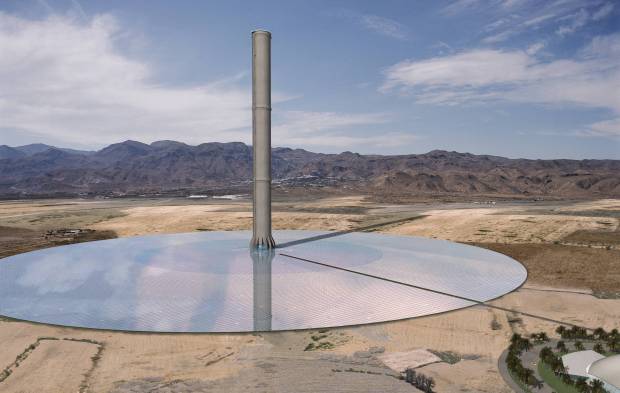 Solar Updraft Tower 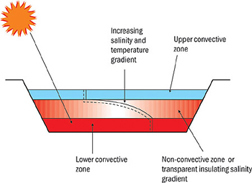 Solar Pond Thermoelectric Power |
Solar chemical
Solar chemical processes use solar energy to drive chemical reactions. These processes offset energy that would otherwise come from an alternate source and can convert solar energy into storable and transportable fuels. Solar induced chemical reactions can be divided into thermochemical or photochemical.
Hydrogen production technologies been a significant area of solar chemical research since the 1970s. Aside from electrolysis driven by photovoltaic or photochemical cells, several thermochemical processes have also been explored. One such route uses concentrators to split water into oxygen and hydrogen at high temperatures (2300-2600 °C). Another approach uses the heat from solar concentrators to drive the steam reformation of natural gas thereby increasing the overall hydrogen yield compared to conventional reforming methods. Thermochemical cycles characterized by the decomposition and regeneration of reactants present another avenue for hydrogen production. The Solzinc process under development at the Weizmann Institute uses a 1 MW solar furnace to decompose zinc oxide (ZnO) at temperatures above 1200 °C. This initial reaction produces pure zinc, which can subsequently be reacted with water to produce hydrogen.
Sandia's Sunshine to Petrol (S2P) technology uses the high temperatures generated by concentrating sunlight along with a zirconia/ferrite catalyst to break down atmospheric carbon dioxide into oxygen and carbon monoxide (CO). The carbon monoxide can then be used to synthesize conventional fuels such as methanol, gasoline and jet fuel.
